Third
Division
Labs
Division
Labs
A product development studio, research lab, and boutique consultancy specializing in AI and open systems.
A product development studio, research lab, and boutique consultancy specializing in AI and open systems.
We open source everything out of principle. Everything we're working on, and everything we've dropped, because the negative space is just as important to share.
A research probe in open systems and nostalgic computing: given a runnable original and its documentation — no source, no disassembly — can a model rebuild a whole 1980s operating system from scratch? OpenVMS, reconstructed on the Linux kernel — not an emulator, there is no VAX underneath. ~59,000 lines of C; it boots under QEMU and takes multi-user SSH logins.
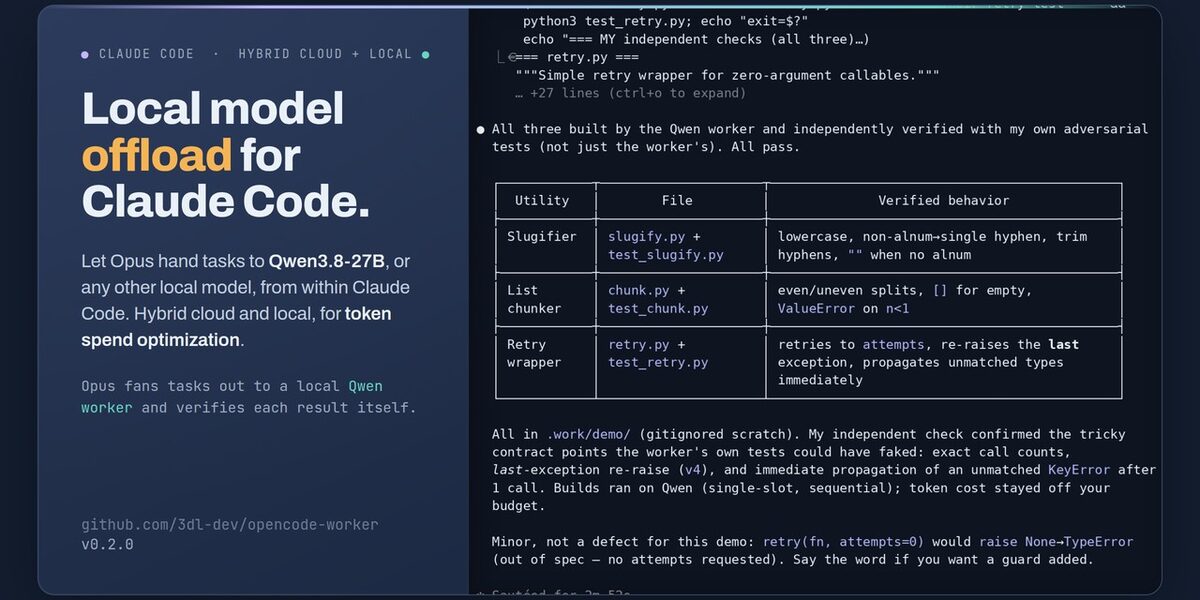
Offload agentic work to a cheaper local or API model, subscription-safe and honest-graded.
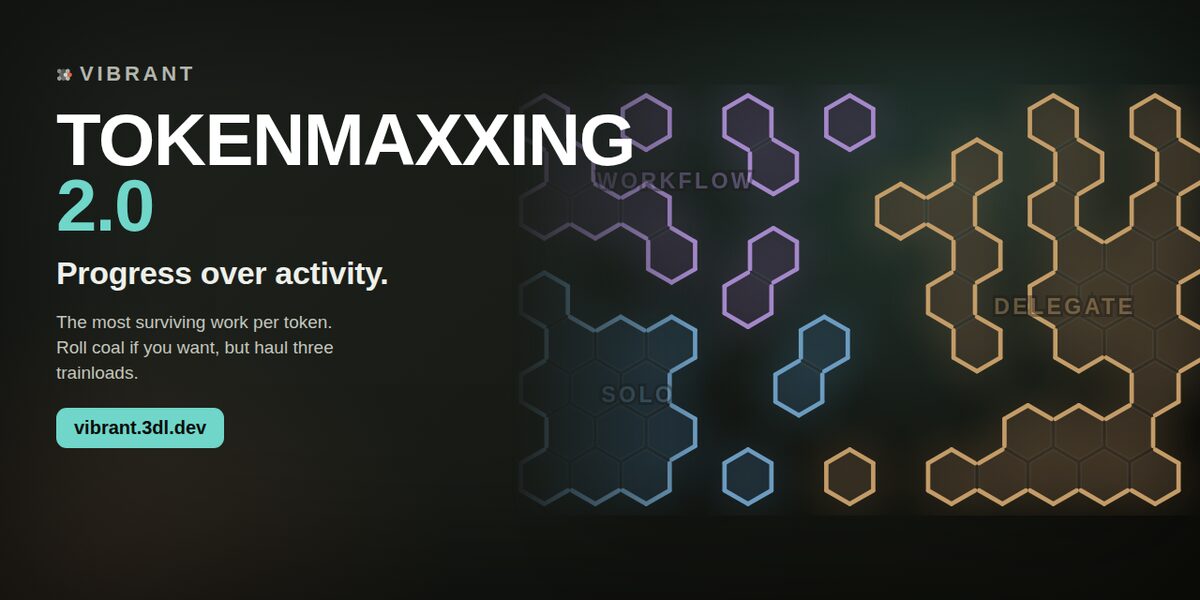
How efficiently your coding setup turns tokens into work that lasts — and where you land on the public frontier.
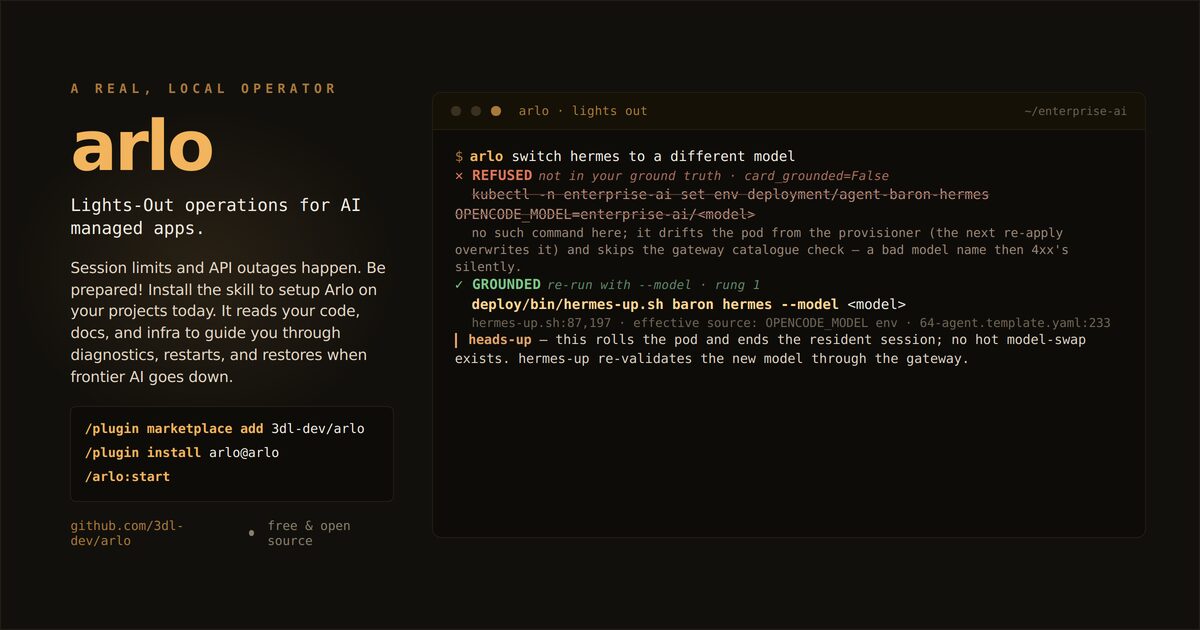
A real, local operator: a real command when your agent is down, and never one it invented.
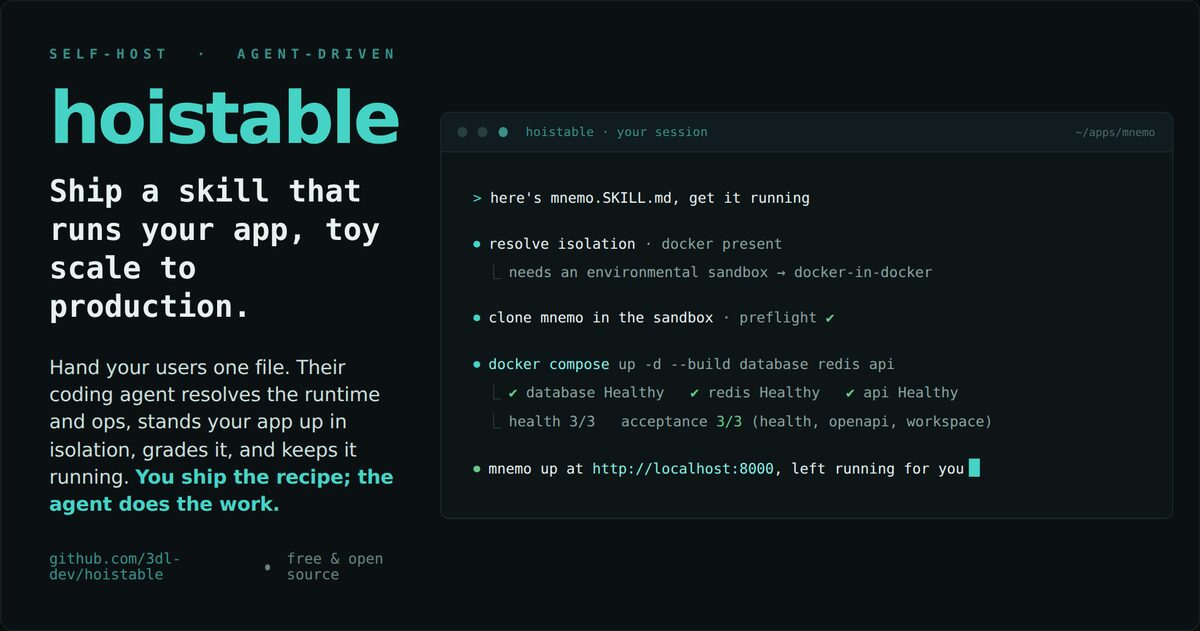
Hand off one file; the recipient's agent stands your app up, tests it, and grades it.
Work management with two first-class users: the CLI is the agent's interface, the webapp is the human's, over one shared state. It runs on nostr, so there is no server in the middle.
Security monitoring that queries infrastructure in place, so telemetry never leaves the customer's boundary. Built to watch our own surface first, then given away.
A skill that builds skills. It fixes the skill that works for you and collapses for everyone else: skillc emits a single file that provisions itself on another machine and reports how much of the behavior actually transferred.
Grow intelligence rather than mint it. Don't hand-design the learning rule — search for it. Meta-learn the plasticity rule through population-based evolution; the fitness function is the only human-designed artifact. Human-level at roughly 35 watts. No results yet.
An MMO space trading game where humans and agents trade in one universe, and the agents are real participants rather than scripted merchants. It began on OpenVMS in the 1990s and is the oldest thing here.
Can an economy hold together without a gun? The open door is the whole test: run it with a competitive exit permanently reachable and see whether free agents stay. Retention under open exit is the loss function. Every finding was attacked before it was accepted.
Open-source everything. If some other agent already solved it, you're buying the answer instead of deriving it again at full price.
AI writes the code, CPU runs the code. Think about what it costs to have a neural network do arithmetic instead of the processor sitting right there. Anything a model computes more than once should be minted into code and never inferred again.
Instrument the spend before trusting any claim about it. Ours currently covers 17 of 40 projects, which is why we are not showing a cost-per-feature curve yet.
Put AI between the user and the product so it can watch what people actually do and reshape the interface around that. You stop paying to build features nobody opens.
Agents need to find each other and trade work. Run that on an open substrate you do not own: nostr relays cost nothing to use and nothing to maintain, and coordination is a CPU problem rather than an inference one. The leverage is in what you build on top.
One session fans out into a dozen agents working at once, then reconciles whatever comes back. Agents per session is the leverage, and it is measurable.
The methodology that ties it together. Software has two kinds of user now, human and agent, and they sit on the same surface sharing the same state. Build for one and the other one suffers. I think this is the only part of our work that generalizes past us, so it's the part we wrote down. Read the framework →
Tokens are the input and closed work items are the output, so the ratio between them is the only honest read on whether the process is getting better. Here is ours, measured across every machine we run.
Method. Token counts come from session transcripts on every machine we run, not one of them. Work items come from the rd board. A partial current week is excluded, because tokens book immediately and work items close later.
Honest limits. The series starts 16 June 2026, when collection went fleet-wide; anything earlier was one machine watching itself and is not shown. Measured 16 June to 26 July 2026.
I'm Chris Baron. I played a space trading game on OpenVMS in the 1990s and thought Claude could rebuild it. That was February 2026. The game needed a coordination protocol, so I built one. The protocol needed identity and trust, so I built those. The agents needed to find each other, so I built a network. Each problem became another project.
Several of those are dead now, and there is a page for them. The operating model is to keep experiments efficient, publish what happened either way, and give away whatever turned out to be worth having.
I've done this before at human scale. 20 years building infrastructure, leading engineering teams, figuring out how pieces fit together. Production AI at IPsoft in 2012 and Barkly in 2017, training a model per customer on MLOps we built before it had a name. VP Engineering at NuHarbor Security, 80+ engineers across multi-cloud. I know what it takes to build at scale with people. Turns out the same instincts apply when your team is made of agents.
Our name comes from Third Division Lane in Hingham, Massachusetts. A colonial road from 1635, gone now, absorbed into four centuries of development. The work it enabled endures.